7 Research-Backed Mediterranean Diet Benefits That Actually Matter
What the Mediterranean Diet Gets Right (And What the Research Actually Says)
The Mediterranean diet is often treated like the gold standard of healthy eating.
It shows up in headlines, doctor’s offices, wellness blogs, meal plans, and longevity conversations. It is praised for heart health, healthy aging, lower inflammation, better blood sugar, and even longer life.
But here is the important question:
What does Mediterranean diet health benefits research actually support — and what has been exaggerated by wellness culture?
The real answer is more interesting than “eat olive oil and live forever.”
The Mediterranean diet is not a magic food list. It is not one single diet. It is not just pasta, fish, red wine, and olive oil. Traditionally, it reflects a broader eating pattern shaped by geography, agriculture, seasonality, cooking habits, and community life across parts of Greece, Italy, Spain, Morocco, Croatia, Cyprus, Portugal, and other Mediterranean regions.
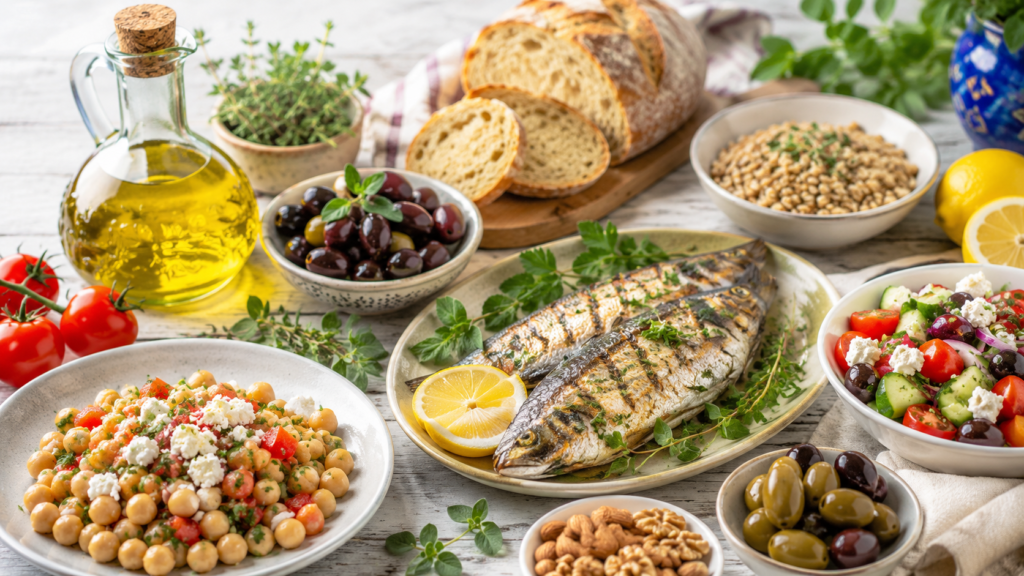
At its best, the Mediterranean diet gets many things right: more plants, more legumes, more whole grains, more olive oil, more seafood, fewer ultra-processed foods, and meals that are built around culture rather than restriction.
But the research also deserves careful interpretation.
This article breaks down what the Mediterranean diet gets right, what the evidence actually says, and what people often misunderstand about it.
What Is the Mediterranean Diet?
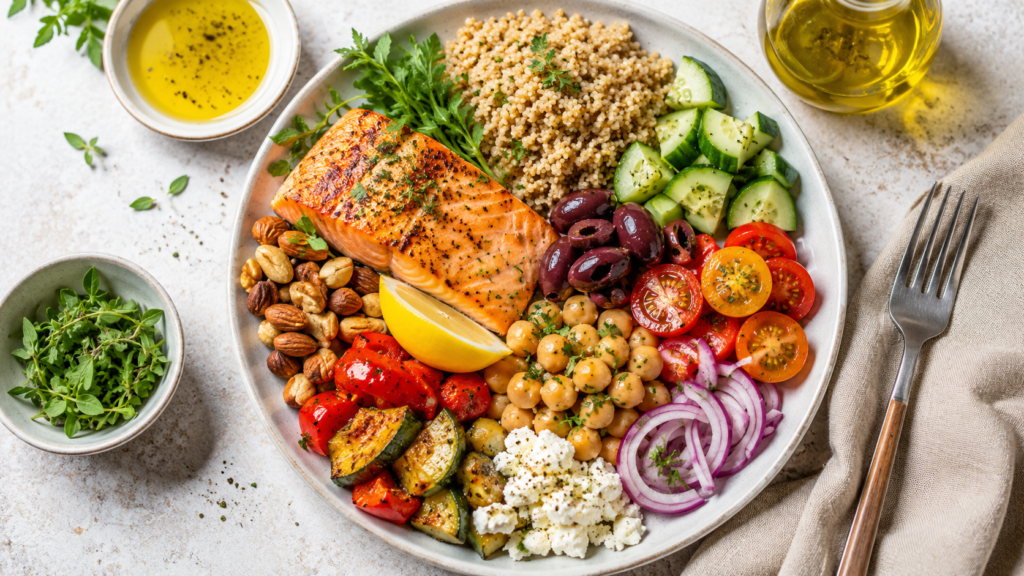
The Mediterranean diet is a traditional eating pattern inspired by the food cultures of countries surrounding the Mediterranean Sea.
It usually emphasizes:
- Vegetables
- Fruits
- Beans, lentils, and chickpeas
- Whole grains
- Nuts and seeds
- Extra-virgin olive oil
- Herbs and spices
- Fish and seafood
- Moderate amounts of dairy, often yogurt or cheese
- Smaller amounts of poultry and eggs
- Limited red meat and processed meats
- Limited sweets and ultra-processed foods
But the Mediterranean diet is also more than nutrients.
It includes cooking at home, eating seasonally, sharing meals, using simple ingredients, and building food habits around daily life instead of short-term dieting.
That matters because many of the diet’s benefits likely come from the full pattern, not from one single “superfood.”
A spoonful of olive oil cannot cancel out a highly processed diet. A salad once a week does not recreate a traditional food culture. And drinking wine because it sounds Mediterranean is not the same thing as following a Mediterranean dietary pattern.
The research is strongest when the Mediterranean diet is studied as a whole pattern.
Why Mediterranean Diet Health Benefits Research Gets So Much Attention
Mediterranean diet health benefits research gets attention because it has been studied for decades across many types of evidence: observational studies, clinical trials, cardiovascular research, diabetes prevention research, and longevity studies.
Unlike many trendy diets, the Mediterranean diet is not built around eliminating entire food groups. It is flexible, realistic, and culturally rooted.
That makes it easier for people to follow long term.
Many diet trends ask people to eat in a way that feels disconnected from normal life. The Mediterranean diet works differently. It encourages foods that are accessible in many forms: beans, vegetables, grains, olive oil, nuts, fish, yogurt, herbs, and simple home-cooked meals.
This is one reason researchers take it seriously. A diet can look perfect in theory, but if people cannot sustain it, its real-world value is limited.
The Mediterranean pattern has survived not because it was designed in a lab, but because it grew out of everyday food traditions.
Benefit 1: It Supports Heart Health
The strongest research around the Mediterranean diet is connected to cardiovascular health.
That makes sense when you look at the pattern.
The diet is rich in unsaturated fats from olive oil, nuts, and fish. It includes fiber from vegetables, fruits, legumes, and whole grains. It tends to be lower in processed meats, refined snacks, and industrially processed foods.
Together, these habits support several markers connected to heart health, including cholesterol balance, blood pressure, inflammation, and blood sugar control.
One of the most discussed Mediterranean diet studies is the PREDIMED trial, which studied people at high cardiovascular risk and compared Mediterranean-style diets supplemented with extra-virgin olive oil or nuts against a lower-fat control diet. The revised analysis still found lower rates of major cardiovascular events in the Mediterranean diet groups.
That does not mean olive oil alone prevents heart disease.
It means a whole dietary pattern built around unsaturated fats, plants, legumes, nuts, and minimally processed foods appears to support cardiovascular health better than many common Western eating patterns.
This is where the Mediterranean diet gets something very right: it focuses on replacement, not just restriction.
It does not only say “eat less bad fat.” It shows what to eat instead.
Benefit 2: It Is Naturally High in Fiber
One underrated reason the Mediterranean diet works is fiber.
Many modern diets are low in fiber because they rely heavily on refined grains, processed snacks, and animal-heavy meals with few plants.
The Mediterranean diet tends to include fiber from:
- Beans
- Lentils
- Chickpeas
- Vegetables
- Fruits
- Whole grains
- Nuts
- Seeds
Fiber supports digestion, helps regulate blood sugar, feeds beneficial gut bacteria, and helps meals feel more satisfying.
This is one reason Mediterranean meals can feel filling without being built around calorie counting.
A bowl of lentil soup with vegetables and olive oil, a chickpea salad, or whole-grain bread with beans and greens offers more than calories. It offers volume, texture, protein, fiber, micronutrients, and slow-digesting carbohydrates.
Mediterranean diet health benefits research often focuses on major outcomes like heart disease and mortality, but everyday benefits may start with simple patterns like eating more fiber-rich foods.
Benefit 3: It Uses Fat Differently
The Mediterranean diet does not treat fat as the enemy.
That is one of its biggest differences from older Western diet advice.
Instead of aiming for extremely low fat intake, the Mediterranean pattern prioritizes better fat sources:
- Extra-virgin olive oil
- Nuts
- Seeds
- Fatty fish
- Olives
These foods provide mostly unsaturated fats, along with polyphenols, antioxidants, and other bioactive compounds depending on the food.
This matters because fat quality appears more important than simply cutting fat as low as possible.
The Mediterranean diet also uses fat in a practical way. Olive oil helps make vegetables taste better. Nuts make snacks more satisfying. Fish adds protein and omega-3 fats. These foods make the diet enjoyable, which helps people stay consistent.
A diet that is technically healthy but miserable is not useful for most people.
The Mediterranean diet gets this right: healthy eating should still taste good.
Benefit 4: It Reduces Reliance on Ultra-Processed Foods
A traditional Mediterranean pattern is built around basic ingredients.
Vegetables. Beans. Grains. Fish. Olive oil. Herbs. Yogurt. Fruit. Nuts.
That automatically reduces reliance on ultra-processed foods, even without obsessing over labels.
This is important because many poor diet patterns are not only high in sugar, salt, or saturated fat. They are also high in convenience foods engineered to be easy to overeat and low in fiber and micronutrients.
The Mediterranean diet does not require perfection. But it does shift the center of the plate away from packaged snacks and toward meals that look like meals.
That one shift may explain a lot of its real-world power.
Instead of asking, “Which single ingredient is responsible?” it may be better to ask:
What happens when most meals come from simple foods instead of ultra-processed products?
That is where the Mediterranean pattern shines.
Benefit 5: It May Support Healthy Aging
The Mediterranean diet is often linked to longevity, but this claim needs nuance.
No diet can guarantee a longer life. Longevity depends on many factors: genetics, income, stress, healthcare access, movement, sleep, environment, social connection, and more.
Still, Mediterranean diet health benefits research has repeatedly connected stronger adherence to the diet with better long-term health outcomes in many populations.
This may be because the diet supports several aging-related systems at once:
- Cardiovascular health
- Blood sugar control
- Lower inflammation
- Gut health
- Weight stability
- Nutrient density
- Reduced exposure to ultra-processed foods
The Mediterranean diet is not a “longevity hack.”
It is a pattern that supports the basics consistently.
And consistency is usually more powerful than hacks.
What People Get Wrong About the Mediterranean Diet
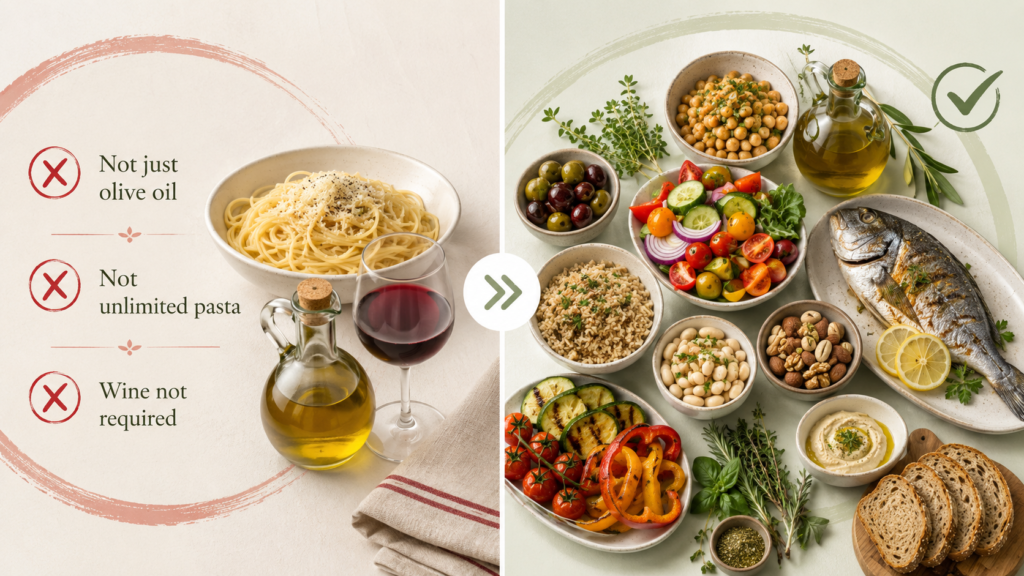
The Mediterranean diet is popular, but it is also often misunderstood.
Here are the biggest myths.
Myth 1: It Is Just Olive Oil
Olive oil matters, especially extra-virgin olive oil, but it is not the whole diet.
A Mediterranean-style diet without vegetables, legumes, whole grains, nuts, and seafood is not really the Mediterranean diet. Adding olive oil to a low-fiber, ultra-processed diet will not create the same pattern studied in research.
Think of olive oil as one part of the structure, not the entire foundation.
Myth 2: It Is Mostly Pasta and Bread
Some Mediterranean cultures include pasta and bread, but the traditional pattern is not built around unlimited refined carbohydrates.
It usually includes grains alongside vegetables, beans, herbs, seafood, olive oil, and smaller portions of animal foods.
The problem is not bread or pasta by themselves. The problem is when Western versions remove the legumes, vegetables, seafood, and seasonal ingredients, leaving only refined starch and oil.
That is not cultural eating. That is selective copying.
Myth 3: Red Wine Is Required
Red wine is often included in popular descriptions of the Mediterranean diet, but it should not be treated as a health requirement.
If someone does not drink alcohol, there is no nutrition reason to start.
The strongest parts of the Mediterranean pattern do not depend on wine. They depend on plants, legumes, healthy fats, seafood, whole foods, and consistent habits.
Wellness culture sometimes turns optional cultural details into universal prescriptions. Red wine is a perfect example.
Myth 4: It Is One Single Diet
There is no single Mediterranean diet.
Greek, Italian, Spanish, Moroccan, Lebanese, Turkish, Croatian, and Portuguese food traditions are not identical. They share some broad patterns, but they differ in spices, grains, legumes, seafood, dairy, cooking techniques, and religious or cultural practices.
This is important because the Mediterranean diet should not be flattened into one generic wellness plate.
Its strength comes from diversity.
The broader lesson is not “eat exactly like one coastal village.”
The lesson is: build meals around plants, traditional staples, healthy fats, shared food practices, and minimally processed ingredients.
Myth 5: It Works Only Because of Individual Foods
Nutrition marketing loves single ingredients.
Olive oil. Salmon. Walnuts. Tomatoes. Red wine. Herbs.
These foods can be valuable, but the Mediterranean diet is not powerful because of one ingredient. It is powerful because of the pattern.
That pattern includes what people eat more of, what they eat less of, how meals are prepared, and how consistently those habits repeat.
A weekly salmon dinner cannot compensate for six days of low-fiber, ultra-processed eating.
The pattern matters more than the occasional “healthy” food.
What the Mediterranean Diet Gets Right
The Mediterranean diet gets several big nutrition principles right without turning them into strict rules.
It Makes Plants the Default
Vegetables, fruits, legumes, herbs, nuts, and whole grains are not side characters. They are central.
It Prioritizes Food Quality Over Calorie Obsession
The pattern focuses less on counting and more on building meals from nutrient-dense ingredients.
It Uses Flavor to Support Consistency
Olive oil, garlic, herbs, citrus, spices, and fermented dairy make healthy foods enjoyable.
It Includes Carbs Without Fear
Beans, fruit, grains, and starchy vegetables are part of the pattern. The difference is that they usually appear with fiber, fat, protein, and whole-food structure.
It Leaves Room for Culture
This may be its most important lesson.
The Mediterranean diet is not just a list of foods. It is a food culture. That makes it easier to sustain than a short-term diet challenge.
What the Research Does Not Prove
Mediterranean diet health benefits research is strong, but it does not prove everything people claim online.
It does not prove that everyone must eat Mediterranean food specifically.
It does not prove that olive oil is a miracle ingredient.
It does not prove that wine is necessary.
It does not prove that other traditional diets are inferior.
And it does not prove that diet alone can overcome every social, genetic, medical, or environmental factor.
This is where DietClash’s perspective matters.
The Mediterranean diet deserves attention, but it should not become another Western-approved standard used to dismiss other cultural diets.
Many traditional food systems around the world share similar strengths: legumes, plants, whole grains, fermented foods, spices, seasonal eating, and lower dependence on ultra-processed products.
The Mediterranean diet is one strong example — not the only example.
How to Apply the Mediterranean Pattern Without Copying It Perfectly
You do not need to eat like a Greek islander or an Italian grandmother to learn from the Mediterranean diet.
Instead, borrow the principles.
Try these simple shifts:
- Add beans or lentils to two meals per week.
- Use olive oil or another unsaturated fat instead of relying heavily on butter or processed dressings.
- Make vegetables a larger part of lunch and dinner.
- Replace some red or processed meat meals with fish, beans, or chickpeas.
- Snack on fruit, nuts, yogurt, or simple whole foods more often.
- Use herbs, garlic, lemon, vinegar, and spices to make simple foods taste better.
- Choose whole grains more often than refined grains.
- Treat sweets and ultra-processed foods as occasional, not daily staples.
- Build meals you enjoy enough to repeat.
The goal is not to perform Mediterranean identity.
The goal is to use the research-backed principles in a way that fits your culture, budget, schedule, and taste.
A Simple Mediterranean-Inspired Day of Eating
Here is one example of what a Mediterranean-inspired day might look like.
Breakfast
Greek yogurt with fruit, walnuts, and a drizzle of honey.
Lunch
Chickpea salad with cucumbers, tomatoes, herbs, olive oil, lemon, and whole-grain bread.
Snack
Fruit with a small handful of nuts.
Dinner
Grilled fish or lentil stew with roasted vegetables, olive oil, herbs, and a side of whole grains.
Dessert
Fresh fruit or a small traditional sweet enjoyed intentionally.
This is not the only way to do it. It is just one example of the pattern: plants, fiber, healthy fats, protein, flavor, and simplicity.
The Bottom Line
The Mediterranean diet deserves much of its reputation, but not because it is magical.
It works because it gets the fundamentals right.
It emphasizes plants, legumes, whole grains, olive oil, nuts, fish, herbs, and minimally processed foods. It supports heart health, fiber intake, healthy aging, and long-term consistency. It also reminds us that food is not just math. Food is culture, rhythm, pleasure, and community.
But the Mediterranean diet should not be treated as the only healthy traditional diet.
The better lesson is bigger:
Healthy eating patterns often come from cultures that built meals around whole foods long before modern nutrition science explained why they worked.
That is what the Mediterranean diet gets right.
And that is what the research actually supports.
Quick Takeaways
- Mediterranean diet health benefits research is strongest for cardiovascular health and long-term dietary pattern quality.
- The diet is not just olive oil, pasta, or red wine.
- Its benefits likely come from the whole pattern: plants, legumes, whole grains, fish, nuts, olive oil, and fewer ultra-processed foods.
- Red wine is not required, and non-drinkers do not need to start drinking.
- The Mediterranean diet is one strong cultural eating pattern, not the only healthy traditional diet.
- The most useful approach is to apply the principles in a way that fits your own culture and lifestyle.
Useful resource : Harvard T.H. Chan School of Public Health Mediterranean Diet Review